
Warmiqs Review: Can This Compact Plug-In Heater Keep Your Space Warm?
A cold home office, chilly bedroom or uncomfortable study corner can make even simple daily tasks frustrating. Turning up the central heating might solve the problem, but heating the entire house just to warm one occupied room may not be the most practical approach.


That is where compact personal heaters enter the picture.
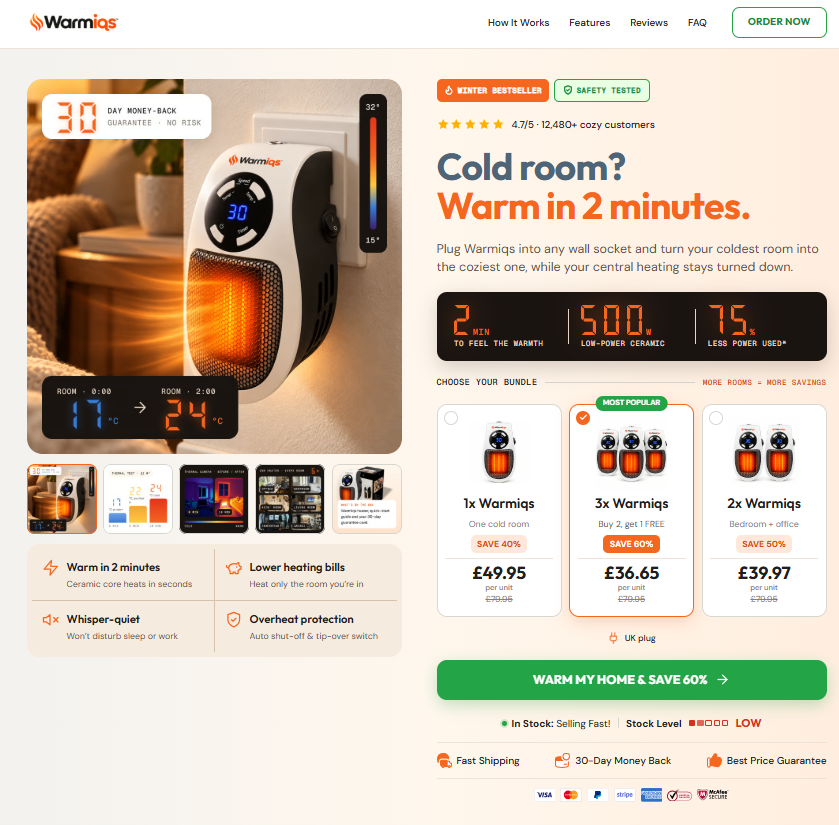
Warmiqs is marketed as a small plug-in electric heater designed to provide targeted warmth in the space where you need it. It combines a ceramic heating element, adjustable temperature controls and a built-in timer in a compact design.
But does its small size make it a worthwhile heating option? How much electricity could it use? And what should UK households know before ordering?
This review examines Warmiqs’ advertised features, practical uses, operating costs, safety considerations and buying information to help you make an informed decision.
What Is Warmiqs?
Warmiqs is a compact plug-in electric heater designed to provide additional warmth in smaller indoor spaces. Instead of heating several rooms at once, it aims to concentrate heat in the area where someone is working, studying or relaxing.
The product information describes a ceramic heating system with a maximum power rating of approximately 500 watts. It also highlights adjustable temperature settings, a digital LED display, a timer and built-in safety mechanisms.
The overall idea is straightforward: switch on the heater when a particular room feels cold, adjust the temperature and use the timer to manage how long it operates.
For people who spend long periods at a desk, sit in a chilly bedroom or want extra warmth in a smaller living area, this type of product may offer a convenient alternative to switching on central heating for the entire property.
However, Warmiqs should be considered a supplementary heating device rather than a replacement for a properly sized room heater or central heating system.
The Main Features That Make Warmiqs Interesting
Warmiqs focuses on convenience rather than complicated installation. Here are the advertised features that deserve attention.
1. Compact Plug-In Design
Traditional portable heaters often occupy floor space and require additional room for positioning. Warmiqs takes a different approach with a compact plug-in format.
You can connect it directly to a suitable wall socket, which removes the need for a separate floor-standing unit.
This design may appeal to people with limited space, including students, home-office workers and households that prefer smaller appliances.
Nevertheless, a compact design does not remove the need for adequate ventilation and safe clearance around a heater.
2. Ceramic Heating Technology
The product information identifies a PTC ceramic heating element as its main heating component.
PTC stands for positive temperature coefficient. This type of ceramic element increases its electrical resistance as its temperature rises, which can help regulate its operating temperature.
In practical terms, the ceramic element generates heat while the appliance distributes warm air into the surrounding area.
Keep in mind that ceramic heating technology does not automatically make an electric heater cheaper to operate than every other electric resistance heater. Actual running costs depend on its power consumption, operating time and your electricity tariff.
3. Adjustable Temperature Settings
Different people prefer different indoor temperatures. Moreover, a small insulated room may need less heating than a colder, poorly insulated space.
Warmiqs product listings describe a temperature adjustment range of approximately 15°C to 32°C.
This gives users the ability to select a preferred setting rather than relying on one fixed heat level.
Before purchasing, check the actual product manual to confirm the available temperature settings and how the thermostat controls the heating cycle.
4. LED Temperature Display
A digital display makes it easier to see the selected temperature and operating settings.
Instead of relying entirely on basic mechanical controls, users can refer to the displayed information when adjusting the heater.
This feature may be particularly convenient when changing settings throughout the day.
5. Built-In Timer
Warmiqs is advertised with a timer offering settings from one to twelve hours.
This feature can help users schedule a heating session around everyday activities.
For example, someone working from home might choose a shorter session during a cold morning. Similarly, a person using the heater in the evening can set an automatic shut-off period.
A timer can reduce unnecessary operating time, but it does not replace safe supervision. Never leave a portable heater operating unattended or while sleeping unless the manufacturer explicitly permits that use and the appliance meets the relevant safety requirements.
6. Advertised Safety Protections
The product listings mention two important safety features:
- Overheat protection: Designed to stop operation if the internal temperature exceeds a specified limit.
- Tip-over protection: Designed to interrupt operation if the appliance falls or changes position.
These features can help reduce certain operating risks. However, no built-in safety mechanism makes an electric heater completely risk-free.
Check the manufacturer’s documentation for the exact protection mechanisms and applicable electrical safety information.
How Does Warmiqs Work?
Warmiqs uses electricity to produce heat through its internal ceramic heating element.
Once connected to a suitable power socket, the heating element warms up. The appliance then uses its airflow system to distribute warm air into the surrounding space.
The process can be understood in four simple stages:
- Connect the heater: Plug the appliance directly into an appropriate wall socket.
- Select your settings: Choose the desired temperature using the available controls.
- Generate warmth: The ceramic element heats up and the appliance distributes warm air.
- Manage operation: Use the built-in timer and thermostat settings according to the product instructions.
The exact time required to make a room comfortable depends on its dimensions, insulation, ceiling height, starting temperature and air circulation.
A small heater may warm the immediate area noticeably without raising the temperature of an entire room to the same extent.
Where Can You Use Warmiqs?
The strongest selling point of a compact heater is its potential convenience in smaller spaces.
Here are some situations where targeted heating may be useful.
Home Office
Working at a desk in a cold room can become uncomfortable, especially during winter mornings.
A supplementary heater may provide extra warmth in the occupied space without requiring the whole house to reach a higher temperature.
Bedroom
Some bedrooms feel colder than other parts of a property. Warmiqs is marketed for small indoor spaces, including bedrooms.
However, always follow the manufacturer’s instructions about unattended operation, sleeping use and safe positioning.
Study Area
Students and people working from home often spend extended periods in one location.
A compact heater may provide an additional source of warmth around a suitable study space, provided it has enough clearance and does not obstruct electrical sockets or furniture.
Small Living Areas
A smaller sitting area may benefit from supplementary heating when the rest of the property does not need additional warmth.
However, do not expect a 500-watt plug-in heater to replace a properly sized heater in a large or poorly insulated room.
Warmiqs Electricity Consumption: What Could It Cost to Run?
Electricity consumption is one of the most important things to investigate before purchasing any heater.
Warmiqs product listings advertise a maximum power rating of approximately 500 watts.
That means it can consume up to 0.5 kilowatt-hours (kWh) for every hour it operates continuously at full power.
Here is a simple illustration:
| Operating time | Maximum electricity consumption |
|---|---|
| 1 hour | 0.5 kWh |
| 2 hours | 1 kWh |
| 4 hours | 2 kWh |
| 6 hours | 3 kWh |
| 8 hours | 4 kWh |
Your actual electricity cost depends on your supplier’s tariff.
For example, at an illustrative electricity rate of 25p per kWh:
- 1 hour: approximately 12.5p
- 2 hours: approximately 25p
- 4 hours: approximately 50p
- 8 hours: approximately £1
These figures are examples, not a statement of the current UK electricity tariff. Actual consumption may also vary because a thermostat can cycle the heating element rather than keeping it continuously at full power.
Does Warmiqs automatically reduce electricity bills?
No. A smaller wattage alone does not guarantee lower household energy costs.
However, targeted heating may help a household reduce total consumption if it allows people to lower central heating use in unoccupied areas. The overall result depends on what heating system it replaces and how long the device operates.
For a fair comparison, calculate the cost of operating Warmiqs and compare it with the heating method you would otherwise use.
How to Use Warmiqs Correctly?
The product is advertised as a straightforward plug-in appliance. Even so, correct operation matters because electric heaters require careful handling.
Follow these practical steps:
Step 1: Read the instructions
Check the supplied manual for electrical requirements, operating limits, clearance distances and approved uses.
Step 2: Inspect the appliance
Before connecting it, check the plug, casing and visible components for damage.
Step 3: Choose a suitable socket
Use a properly installed wall socket that matches the appliance’s electrical rating. Avoid extension leads, multi-plug adapters and overloaded sockets.
Step 4: Select a comfortable setting
Adjust the temperature using the available controls. Start with a moderate setting and change it gradually if necessary.
Step 5: Set the timer
Choose an appropriate operating period according to your routine and the manufacturer’s instructions.
Step 6: Switch off safely
Turn off and unplug the appliance when it is not required, following the manual’s instructions.
Warmiqs Safety: Important Things Every Buyer Should Know
Safety deserves as much attention as heating performance.
Although the product listings mention overheat and tip-over protection, users should still follow basic electric-heater precautions.
- Keep the heater away from curtains, bedding, paper, clothing and other combustible materials.
- Never cover the air inlet or outlet.
- Avoid using the appliance near water or in damp locations unless the exact model carries the required rating.
- Do not insert objects into the air openings.
- Keep children and pets away from the appliance.
- Do not use a damaged plug, socket or heater.
- Avoid extension leads and overloaded electrical connections.
- Unplug the heater before cleaning or inspecting it.
- Stop using it if you notice smoke, burning smells, unusual noises or signs of electrical damage.
Also, do not assume that a plug-in heater is safe to use in a bathroom simply because it has a compact design.
Before buying, check the manufacturer’s identity, model number, electrical rating, safety documentation and applicable UK conformity information. A seller’s general statement about safety certification is not a substitute for checking the actual product documentation.

Warmiqs Advantages and Limitations
A useful product review should explain both what a product offers and where it may fall short.
Potential Advantages
- Compact format that does not require a traditional floor-standing heater.
- Advertised ceramic heating element.
- Adjustable temperature settings.
- LED display for viewing operating settings.
- Built-in timer for planned heating sessions.
- Advertised overheat and tip-over protection.
- Potentially useful as supplementary heating in smaller spaces.
Points to Consider
- A 500-watt appliance may not provide enough output for a large room.
- Actual heating performance depends on room conditions.
- Electricity costs still accumulate during operation.
- Energy savings are not guaranteed.
- Safety features do not eliminate the need for careful use.
- Independent performance testing and detailed technical specifications should be checked before purchase.
Warmiqs Price and Ordering Information in the UK
The affiliate link supplied for this review uses the Warmiqs UK offer page. However, the page did not load successfully during verification, so I could not independently confirm its current checkout prices, stock status, delivery charges or refund conditions.
Other online Warmiqs product listings display indicative prices around £49.95 for a single unit and lower per-unit prices for multi-unit bundles. These listings are not sufficient to establish the current official offer.
Before ordering, check the following information directly at checkout:
- Current single-unit price.
- Bundle prices and the final total.
- Whether delivery costs extra.
- Dispatch and estimated delivery times.
- The seller’s returns and refund policy.
- Warranty information.
- Customer service contact details.
- Whether the product specifications match the advertised model.
Do not rely on an old promotion or a price displayed by an unrelated retailer. The amount shown on the final payment page is the price that matters.
Is Warmiqs Better Than a Traditional Space Heater?
That depends on the space you want to heat.
Warmiqs is marketed as a compact, low-wattage option for targeted warmth. A conventional portable fan heater or oil-filled radiator may offer higher power output and suit larger rooms better.
Consider these differences:
| Feature | Warmiqs | Traditional portable heater |
|---|---|---|
| Design | Compact plug-in format | Often floor-standing |
| Advertised power | Up to approximately 500 W | Varies by model |
| Best use | Supplementary heating | Depends on power and design |
| Portability | Small format | Varies |
| Controls | Advertised display and timer | Varies by model |
| Room coverage | Depends on room conditions | Depends on model and output |
Neither design is automatically the better choice for every household.
If you want to heat a large living room, compare the output and tested room-heating performance of properly rated alternatives. If you only need additional warmth in a small occupied space, a compact device may be more convenient.
Who Should Consider Warmiqs?
Warmiqs may interest people who:
- Want supplementary warmth in a smaller indoor space.
- Prefer a compact appliance over a larger floor-standing heater.
- Work or study in a chilly room.
- Want temperature and timer controls.
- Are comparing lower-powered heating options for occasional use.
It may not suit people who need to heat large rooms, replace their main heating system or operate a heater in an environment that does not meet the product’s safety requirements.
Final Verdict: Is Warmiqs Worth Considering?
Warmiqs takes a simple approach to a familiar winter problem: staying comfortable without necessarily heating every room in the home.
Its advertised combination of a ceramic heating element, temperature controls, digital display and built-in timer gives it an appealing feature set for people seeking supplementary warmth in smaller spaces.
Nevertheless, buyers should look beyond the promotional claims. The advertised 500-watt rating provides a useful starting point for estimating electricity consumption, but it does not prove that the appliance will heat every room effectively or reduce household bills.
The most sensible approach is to compare its specifications with your actual heating needs, verify the product’s electrical safety documentation and check the complete purchase terms before ordering.
Our overall view: Warmiqs is worth investigating as a compact supplementary heater, particularly if you want targeted warmth rather than a large portable appliance. However, confirm its performance, safety information and current UK offer before making a purchase.